
New World Screwworm
The New World screwworm (Cochliomyia hominivorax) is a devastating parasitic fly. The larvae (maggots) feed exclusively on the healthy, living tissue of mammals (and rarely, birds). Adult female flies lay eggs near the edges of wounds or moist body orifices (nose, ears, genitals, navel of newborn animals). Entry point wounds can be surprisingly small, such as a tick bite or a minor scratch. Eggs hatch within 12 to 24 hours. The emerging larvae immediately burrow deep into healthy tissue, tearing it with sharp mouth hooks. This rapidly enlarges and deepens the wound, creating extensive tissue destruction. Infestations cause intense pain and discomfort. If left untreated, severe infestations can quickly become fatal to the host.
If you suspect NSW infestation: Contact the APHIS VS Area Veterinarian in Charge (AVIC) for your state and your State Animal Health Officials (SAHO) immediately.
Do not attempt to treat or extract the larvae at home.
Daily Surveillance & Prevention Protocols
Active monitoring is the most effective way to protect animals from infestation.
- Ensure your dogs are on parasite prevention. Tick bites and skin scratches can serve as entry points for female flies to lay their eggs.
- Keep your dog away from livestock, particularly during peak fly seasons or in areas with reported outbreaks.
- If you rescue, sell, buy, or import dogs, be extra vigilant. Carefully inspect every animal before and after travel.
- Inspect animals daily for any signs of skin breaks, scratches, or potential wounds.
- Provide strict care, monitoring, and proper dressing for all wounds, including recent surgical incisions (e.g., spay/neuter sites, tail dockings, ear croppings, or amputations).
- Monitor for a foul odor, visible tissue damage, or the presence of moving larvae inside a wound.
- Watch for behavioral signs of irritation, such as head shaking, pawing at the face (if the ears, eyes, or nose are affected), intense scratching, biting, or licking at a specific site.
- Animals may lose interest in food, become lethargic, or self-isolate.
- Secondary bacterial infections can occur, leading to symptoms like fever or chills.
Treatment
If NWS is confirmed, the animal and the environment must be treated in accordance with standard operating procedures.
- Affected animals must be quarantined under the supervision of a USDA-accredited or official state/federal veterinarian.
- All visible eggs and larvae must be manually extracted and safely disposed of. Wounds must be thoroughly cleaned, disinfected, and managed with advanced wound care. Pain management and systemic antibiotics might be necessary.
- Treatment requires a combination of an effective systemic larvicidal medication alongside appropriate topical treatments.
- The animal must be re-inspected 24 hours after treatment to ensure no live larvae remain. The animal can be released from quarantine only after an official veterinarian confirms it is completely free of larvae.
Population Control & Eradication
While approved pesticides may be used locally against NWS populations to reduce immediate pressure quickly, long-term eradication relies on the Sterile Insect Technique (SIT). This biological control method involves releasing mass-reared, sterile male flies into affected areas. When wild female flies mate with these sterile males, they produce unfertilized eggs. Because female screwworm flies only mate once in their lifetime, the wild population progressively shrinks and ultimately dies out.
Resources
- Screwworm.gov USDA – APHIS
- New World screwworm (NWS) AVMA
- New World Screwworm: What dog owners need to know American Kennel Club
- Animal Drugs for New World Screwworm U.S. Food and Drug Administration
- New World Screwworm: Indiana’s Updated Animal-Movement Requirements Indiana State Board of Animal Health
- New World screwworm – What You Need to Know CDC
FREQUENTLY ASKED QUESTIONS
How does NWS spread?
NWS spreads primarily through the movement of infested animals carrying adult flies or live larvae, particularly when traveling from affected regions. Additionally, adult NWS flies are strong fliers capable of traveling over a dozen miles on their own.
- NWS can affect all warm-blooded animals. While most cases occur in livestock (cattle, sheep, and goats), pets and wildlife are also susceptible.
- Infestation begins when a female fly deposits eggs on the edge of an open wound or a moist body orifice. Common entry points include wire cuts, insect bites, and wounds from animal husbandry.
- One female can lay 200 – 300 eggs at a time and may lay up to 3,000 eggs during her 10- to 30-day lifespan.
- Larvae emerge within 12 to 24 hours of egg deposition. They are very small and highly difficult to detect during the first day or two of life.
- Once the eggs hatch, the larvae burrow deep into the wound to feed on living tissue. After feeding for about seven days, these mature maggots drop from the animal, burrow into the soil, and eventually emerge as adult flies.
What is New World Screwworm (NWS)?
The New World screwworm (Cochliomyia hominivorax) is a parasitic fly whose larvae (maggots) feed exclusively on the living tissue of warm-blooded hosts, which distinguishes NWS from common blowflies, whose maggots only feed on dead or decaying tissue.
What does a screwworm parasite look like?
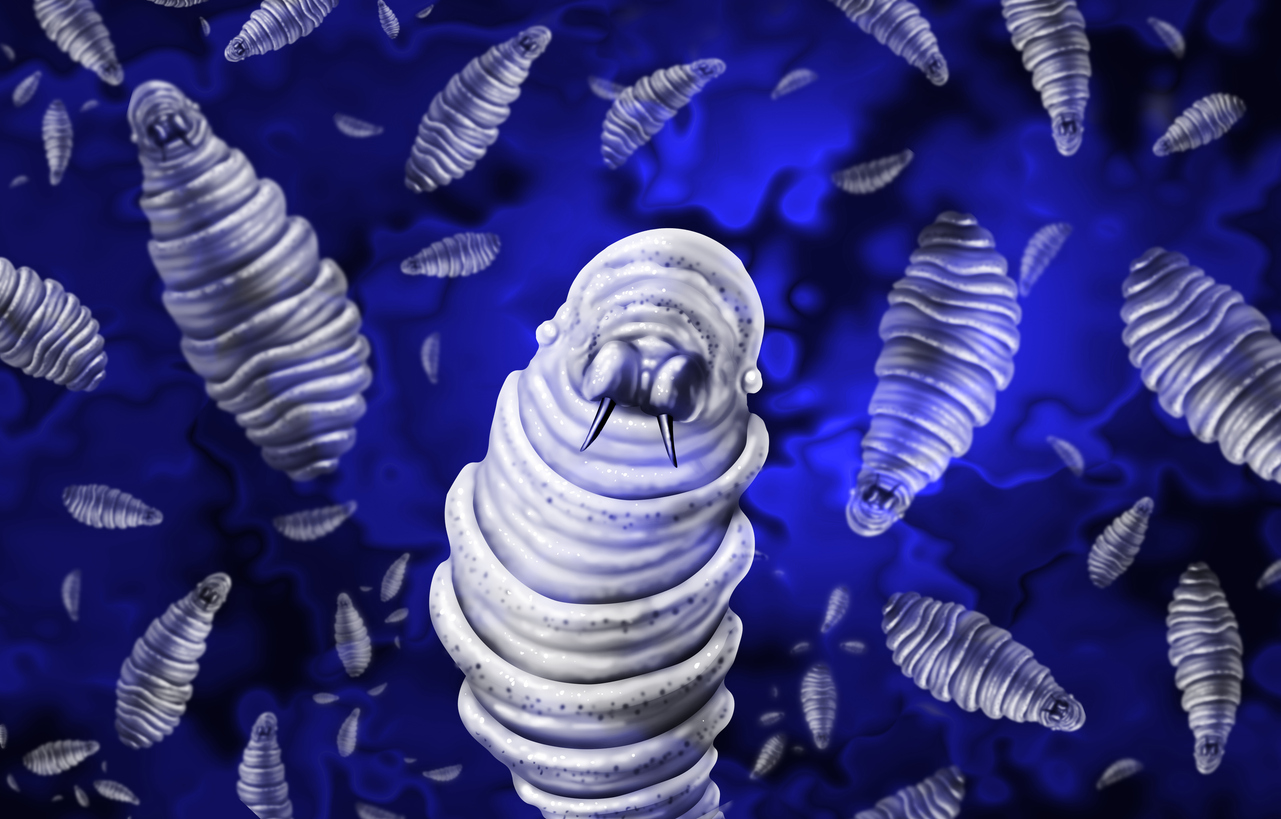
It is a white to pale yellow cylindrical, tapered worm that can grow up to about 2/3 of an inch (1.7 cm) long when fully mature. They get their name from the distinct, dark, tiny bands of sharp spines that encircle each body segment, making them look remarkably like a wood screw. At the narrow, tapered front end of their body, they possess a pair of prominent, dark, hook-like mouthparts.
What are the symptoms of a NWS infestation?
- Open, painful wounds containing visible maggots. The wound typically deepens and expands over time as larvae feed on healthy flesh.
- A blood-tinged fluid seeping from the wound, accompanied by a foul, characteristic odor.
- Infested animals show signs of intense discomfort, irritation, and sudden loss of appetite.
Are dogs at risk?
Yes. While livestock are the primary targets, NWS can also infest dogs and cats.
- Free-roaming, stray, recently rescued, or transported dogs are at the highest risk.
- For the majority of household pets, immediate risk remains low. You can effectively protect your dog through routine skin checks, prompt wound care, and immediate veterinary attention for any unusual skin lesions.
- If you travel with dogs or are involved in rescue, transport, or international importation, extra vigilance is warranted. Carefully inspect all animals before and after transit.
Can humans contract New World screwworms? How do I protect myself?
Human NWS infestations are rare compared to animal cases, typically occurring when individuals with open wounds spend time in areas where the flies are present.
- The flies do not bite. Instead, females deposit eggs in open wounds or natural body openings.
- Keep all cuts, scrapes, and surgical wounds clean, covered, and properly treated.
- Individuals working closely with livestock, wildlife, or sheltered animals in affected areas must practice rigorous hand hygiene and routinely inspect themselves for scratches or bites.
Can the FDA-authorized screwworm medications be used as a routine preventative for dogs?
No. While the FDA has issued emergency authorizations and conditional approval for several drugs to combat NWS, the options for dogs are currently limited to treating active infestations rather than preventing them. Therefore, routine parasite prevention is still important as tick bites and skin scratches serve as entry points for female flies to lay their eggs.
What should I do if I suspect an NWS infection?
Because New World screwworm is a reportable foreign animal disease in the U.S., suspected cases must be reported to the Animal and Plant Health Inspection Service (APHIS) and state animal health officials. If you suspect a screwworm infestation in any animal, follow USDA-APHIS standard operating procedure for possible detections of NWS in animals.
Do I need a certificate to travel with my dog to another state?
There are no movement requirements for animals originating outside an NWS Infested Zone and moving into the zone. If your dog is originating from or passing through a state with active NWS Infested Zones, some states require a Certificate of Veterinary Inspection (CVI), issued by a veterinarian after examining your pet for any open wounds or signs of screwworm larvae infestation. Because pet travel regulations are changing, be sure to check the USDA-APHIS website for your destination’s specific state or territory entry requirements before you go.
Topic(s): Bare Bones Basics, Breeder Resource, Health, Preventative Care, Preventative Health Care - Parasite Screening & Prevention